Investing Using Margin...The Margin Loan Can Giveth, Or It Can Taketh Away
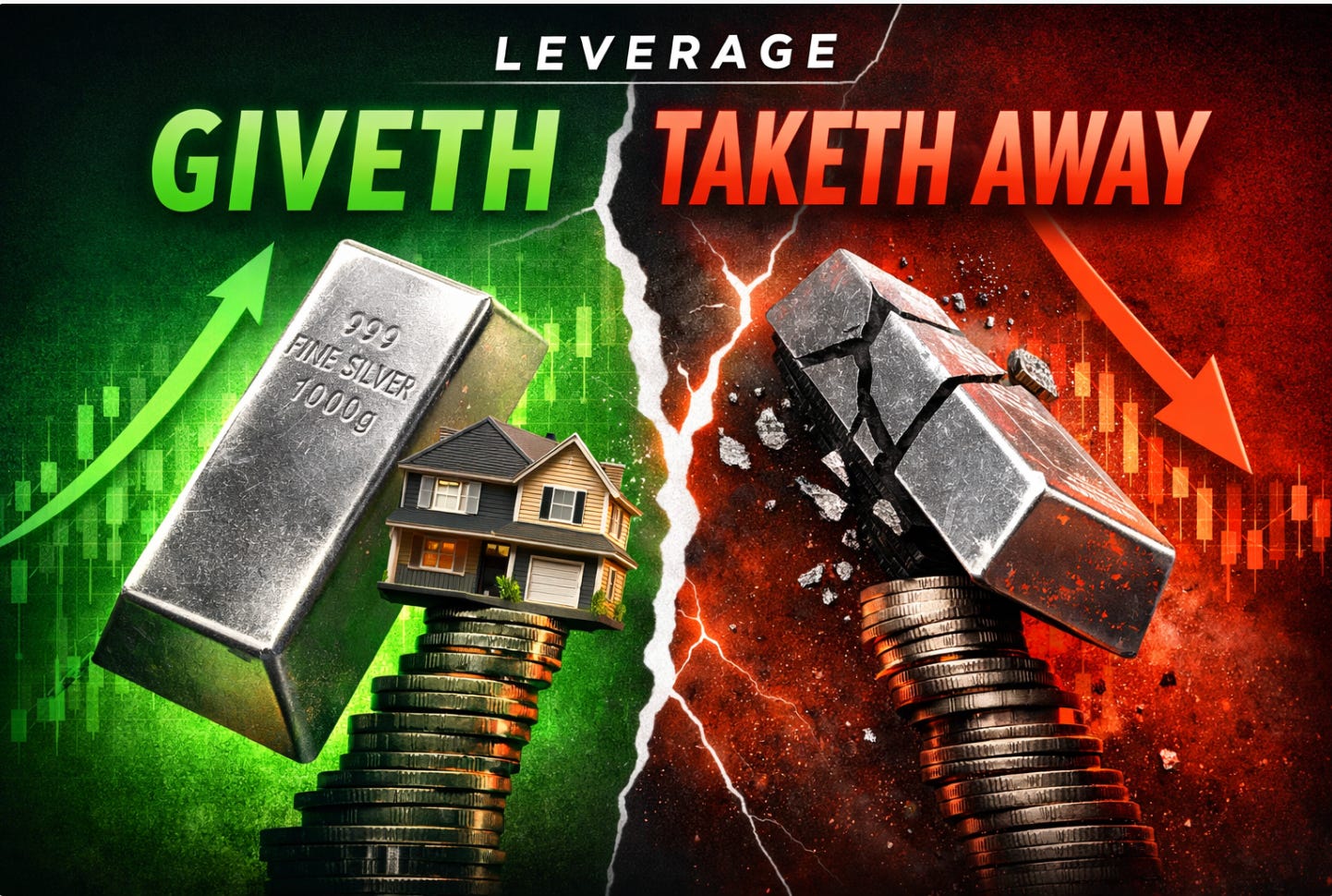
How Silver, Trading Above $80 an Ounce and Then Crashing 8% in 24 Hours, Is A Great Example Of The Risk in Leveraged Investing and Real Estate

As a former bond and equity trader, Hallmark Abstract Service CEO Mike Haltman knows well the risks and rewards of using leverage.
While the upside can be amplified, so too can the downside, as witnessed in the silver market over the past couple of days.
This article is a primer on margin…
(To receive new articles from Mike Haltman, type your email in the box below.)
What “Buying on Margin” Means
When you invest on margin:
You put up some of your own money (equity)
Your broker lends you the rest
The investment itself acts as collateral
You pay interest on the borrowed amount. The real estate example of buying on margin is below.
A Simple Example
You have $10,000.
Without margin: you buy $10,000 of stock
With margin (50% requirement):
You use $10,000 of your money
Borrow $10,000 from your broker
Buy $20,000 of stock
If the investment rises 10%:
Portfolio becomes $22,000
You repay the $10,000 loan
You now have $12,000
Your return = +20%
If the investment falls 10%:
Portfolio becomes $18,000
You still owe $10,000
You now have $8,000
Your loss = −20%
Margin magnifies outcomes.
Margin Calls (The Big Risk)
If your investment falls too much:
Your equity drops below the broker’s minimum
You get a margin call
You must:
Add more cash or
Sell assets immediately
If you don’t act fast, the broker can liquidate positions without your consent.
This often happens at the worst possible time—during market stress.
Why Margin Works…Until It Doesn’t
Margin works best when:
Markets are rising
Volatility is low
Liquidity is abundant
Interest rates are low
Margin fails when:
Rates rise
Volatility spikes
Liquidity dries up
Assets move together (correlation = 1)
That’s why margin can turn a correction into a crash.
The Bottom Line
Margin doesn’t change whether an investment is good or bad.
It changes how fast and how hard the outcome hits you.
Or more bluntly:
Gains feel smarter
Losses feel unfair
The math doesn’t care
1. Housing Is Margin — Just With Better Marketing
When a buyer puts 5%–20% down and borrows the rest, they’re effectively using margin:
Their down payment = equity
Their mortgage = borrowed funds
The house = collateral
Just like margin:
Rising prices magnify gains
Falling prices magnify losses
Higher rates increase carrying costs
The difference is psychological, not mathematical.
2. Mortgage Rates Are the “Interest Cost” on Housing Margin
In margin investing:
Rising margin rates force liquidation
Higher interest eats returns
In housing:
Rising mortgage rates:
Reduce affordability
Raise monthly payments
Shrink buyer demand
Pressure prices
When mortgage rates move from 3% to 6–7%, the cost of leverage doubles — even if the loan balance doesn’t change.
That’s the equivalent of your broker doubling margin rates overnight.
___________________________________
Are You Buying Commercial or Residential Property in New York?
When you’re signing the contract, here’s something most buyers don’t realize:
You, not the seller, not the lender, and not your attorney, have the right to choose your title insurance provider.
And the firm you choose can make all the difference in how well your investment is protected.
At Hallmark Abstract Service, we don’t just issue a policy.
With a laser focus, we uncover risks others may miss, work to protect what may be the largest financial commitment of your life, and stand by you long after closing.
If you want to understand what truly separates one title provider from another, take a moment to read our guide:
“Due Diligence Deep Dive: How to Choose a New York Title Insurance Provider,” here https://www.linkedin.com/pulse/top-reasons-new-york-homebuyers-can-should-choose-michael-aw12e/.
When you’re ready, we’re here to help.
Hallmark Abstract Service
You Buy Real Estate. We Protect It.
Michael Haltman, CEO
mhaltman@hallmarkabstractllc.com
New York City: (646) 741-6101
Long Island: (516) 741-4723